

Air-Cooled vs Water-Cooled Laser Cleaners: Which Is Right for You?
Oct 16, 2026
The choice between an air-cooled and a water-cooled laser cleaning machine primarily depends on laser power, the intended application environment, and the required duration of continuous operation. Air-cooled systems offer the advantage of being lightweight and flexible, making them well-suited for low-to-medium power applications and on-site operations; water-cooled systems provide superior cooling efficiency, ensuring stable, continuous performance for high-power equipment.
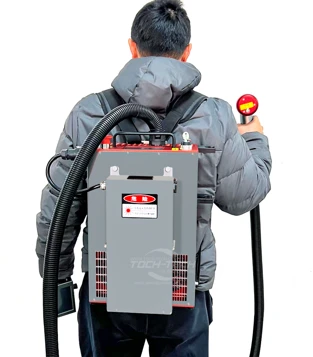
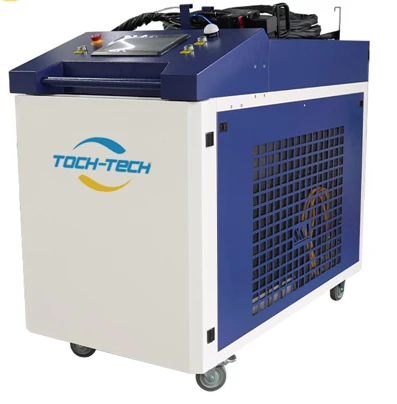
Air cooled laser cleaning machine Water cooled laser cleaning machine
1. Air-Cooled
Applicable Power: 100W–1000W (commonly for 100W-500W pulsed laser systems).
Portability and Weight: Excellent. The complete unit typically weighs between 35 kg and 70 kg; some models are designed in a suitcase or backpack style.
Continuous Operation Capability: Moderate. Suitable for intermittent tasks; some high-quality models can operate continuously for 8 hours at 40°C without performance degradation.
Environmental Adaptability: Strong. Can be used in temperatures ranging from -20°C to 50°C, as well as in water-scarce, cold, or outdoor environments, with no risk of water leaks or freezing damage.
Maintenance Cost: Low. Features a simple design and is essentially maintenance-free, requiring only periodic cleaning of the dust filter.
2. Water-Cooled
Applicable Power: 1000W–6000W+ (commonly found in 2000W/3000W continuous-wave laser systems).
Portability and Weight: Poor. The complete unit typically weighs between 85 kg and over 260 kg; it requires a water tank or cabinet, making it difficult to move.
Continuous Operation Capability: Exceptional. Specifically designed for heavy-duty industrial cleaning, capable of running uninterrupted for 24–72 hours with excellent thermal stability.
Environmental Adaptability: Limited. Requires freeze protection; in extremely cold regions, antifreeze must be added to prevent the system from freezing.
Maintenance Cost: Relatively High. Requires regular checks of water quality, periodic replacement of circulating water or antifreeze, and monitoring to prevent leaks in the plumbing system.
3. How to choose: It depends on the application.
When to Choose Air-Cooled Systems:
Application: Outdoor construction, ship maintenance, cultural relic restoration, high-altitude work, or field maintenance tasks that require frequent relocation.
Budget: Air-cooled models are typically 20%–30% cheaper than water-cooled models of the same power, with no additional costs for a separate water-cooling unit.
Caveats: Do not choose an air-cooled system if your cleaning tasks involve removing thick layers of rust or large areas of paint. Air-cooling has limited heat dissipation capacity; prolonged operation at full load can cause the laser to overheat, leading to a drop in performance (throttling) or even a shortened service life.
When to Choose Water-Cooled Systems:
Application: Fixed factory production lines, large-scale rust removal, maintenance of heavy equipment (such as rail carriages or large molds), or high-intensity operations requiring 24-hour, three-shift cycles.
Efficiency: Water-cooling offers 2–3 times the heat dissipation efficiency of air-cooling, ensuring the laser operates at an optimal temperature-which typically boosts cleaning efficiency by 30%–50%.


